
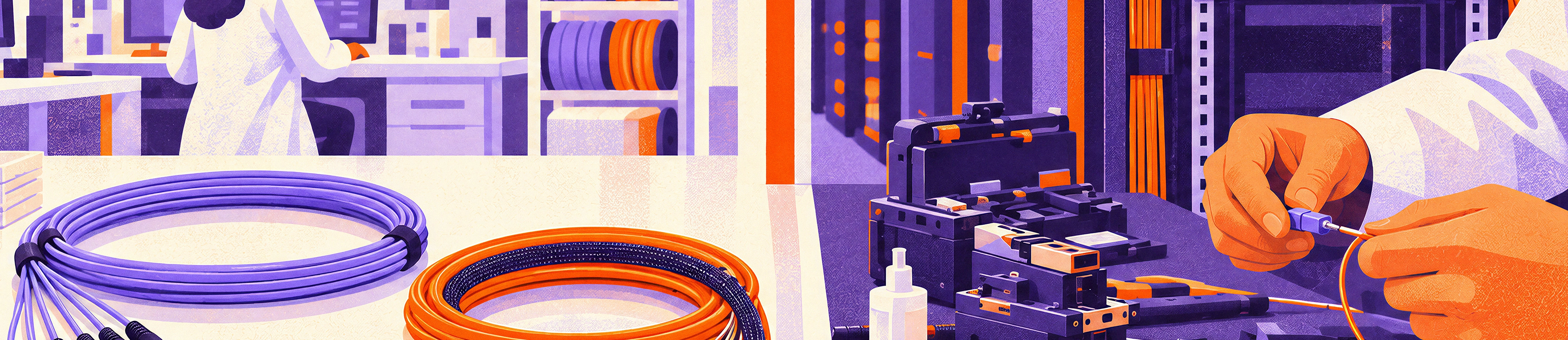
Pre-Terminated Termination vs. Field Termination
When each option makes sense: benefits, risks, and decision logic
When designing a structured cabling network — whether copper or fiber optic — there comes a moment when you have to answer a question that seems simple but carries enormous implications for cost, schedule, and reliability: do we terminate the cables at the factory before they reach the site, or do we terminate them in the field, on-site, during installation?
Neither option is “better” in absolute terms. They are two different work philosophies, each with its own balance between flexibility, speed, cost, and quality control. This article reviews what each approach involves, its benefits and risks, and offers practical decision logic for choosing the right option based on the project’s context.
Two Ways of Understanding Termination
Field termination (in-situ): means installing the connectors — RJ45 plug or jack, LC/SC fiber connectors, fusion splices, etc. — directly on site, after the cable has been run between two points. The technician cuts, prepares, connects, and tests each link at the location itself.
Pre-terminated termination (factory termination): involves manufacturing cable assemblies — copper or fiber trunks, patch cords, cassettes — already assembled and tested at the factory, in a controlled environment, and shipping them to the site ready to connect (“plug and play”).
Both methods coexist in the market, and in fact it’s common to combine them within the same project: for example, pre-terminated trunks together with field termination at the workstations.
Benefits of Pre-Terminated Termination
- Quality and repeatability: because they are manufactured in a controlled environment, with precision machinery and standardized processes, the connectors have more consistent geometry and polish than those made by hand, resulting in better insertion loss and return loss values in fiber, and better control of untwisting in copper.
- Factory testing included: the assemblies arrive already tested (attenuation, crosstalk, continuity, etc.), with their corresponding report.
- Reduced installation time: since no cable preparation, splicing or crimping tools, or epoxy curing are required, installation is much faster — various manufacturers cite installation time reductions of between 50% and 75% compared to field termination.
- Less dependence on installer skill: much of the risk of human error associated with poor polishing, bad crimping, or excessive untwisting — common causes of intermittent field failures — is eliminated.
- Fewer tools and less waste: there’s no need to bring splicing machines, crimping tools, polishing kits, or consumables to the site, which also reduces material waste.
This approach is especially popular in data centers, where pre-terminated copper and fiber trunks are widely used to connect switches, servers, patch panels, and distribution areas, precisely because of the deployment speed and reliability they provide in high-density environments.
Risks and Limitations of Pre-Terminated Termination
- Need for precise measurement in advance: since they are manufactured to a fixed length, any measurement error in the project means having to order a new cable, with the resulting delay and additional cost.
- Less flexibility for last-minute changes: in buildings with irregular layouts or when the final cable route isn’t fully defined, a pre-terminated trunk can end up too short or with excess length.
- Higher material cost: the price of a pre-terminated assembly is usually higher than that of “bulk” cable plus loose connectors, although this extra cost is typically offset by savings in labor and time.
- Manufacturing lead times: since it’s a custom-made product, a delivery lead time must be factored into the project schedule.
Benefits of Field Termination
- Maximum flexibility in length and routing: the cable is cut to the exact length once it has been run, which is very useful in large buildings, irregular layouts, or when distances aren’t known precisely until the cable is pulled.
- Easier bulk cable pulling: unterminated cable is easier to route through conduits, trays, and wall penetrations, since there are no connectors on the ends.
- Quick on-site repairs: if a link is damaged, it can be worked on and re-terminated directly at the point of failure, without depending on a new factory order.
- Lower material cost per meter: bulk cable and loose connectors tend to be more economical than the equivalent pre-fabricated assembly.
Risks and Limitations of Field Termination
- Higher labor cost and time: it requires trained technicians, specific tools (crimping tools, splicing machines, polishing kits, certification equipment), and more work steps, which makes installation more expensive and longer.
- Quality dependent on technician skill: the final performance of the link — especially in fiber, where polishing and alignment are critical — varies depending on the experience of whoever performs it, which can lead to rework.
- Risk of exceeding standard tolerances: ISO/IEC 14763 standards set, for example, strict untwisting limits for copper (no more than 13 mm for category 6A) to prevent crosstalk (NEXT); exceeding these due to poor practice on site is a common error and can cause transmission errors.
Decision Logic: Which Option to Choose?
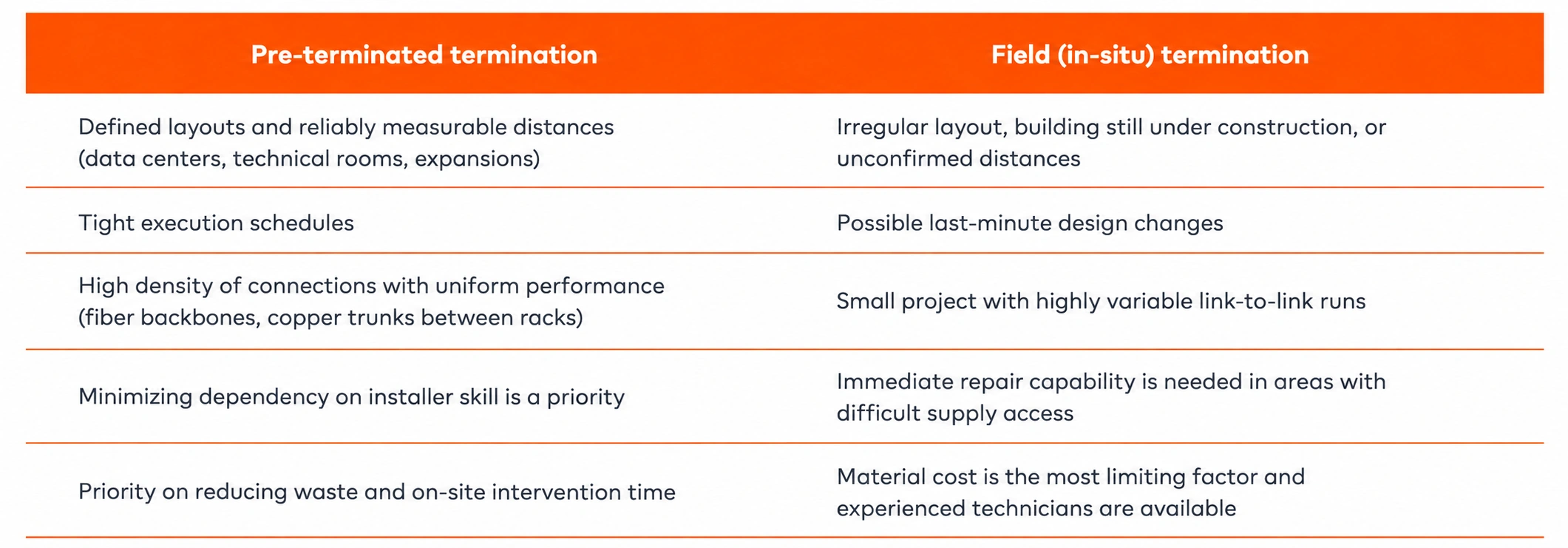
There’s no single rule, but there are criteria that help make a sound decision. The following table summarizes when the balance tips toward each approach:
The Role of Controlled Manufacturing: Our Higgs Laboratory
One of the underlying arguments in favor of pre-termination is, precisely, the quality that only a controlled manufacturing environment can offer. At barpa, this philosophy is the reason behind Higgs, our line of pre-terminated fiber optic and copper solutions manufactured in Portugal.
At our Higgs Laboratory we develop and manufacture custom fiber assemblies — trunks, patch cords, and cassettes — each with a serial number for traceability, under an ISO 9001:2015 quality management system and in compliance with industry standards such as IEC 61300, IEC 61754, and ISO/IEC 11801.
Customization is the core focus: we adapt configurations, connector type, fiber count, and lengths to the real needs of each project, backed by the factory guarantees this article identifies as one of the major advantages of pre-termination.
If your next project fits the profile of a data center, a high-density trunk, or an installation with tight deadlines, at barpa we can help you assess whether a pre-terminated Higgs solution offers the best balance of reliability, time, and cost.
Pre-terminated or field-terminated? Let’s decide together.
Tell us about your project’s characteristics and our technical team will help you define the combination of pre-terminated and field termination that best balances schedule, cost, and reliability — including, if it fits, a custom Higgs solution manufactured in our laboratory.
Conclusion
The choice between pre-terminated and field termination shouldn’t depend on habit, but on context: project type, precision of available measurements, schedule, budget, and the criticality of network performance. Understanding the real benefits and risks of each approach — and not being afraid to combine them when the project calls for it — is what makes the difference between an installation that works from day one and one that causes problems for years.

Sorry, the comment form is closed at this time.