

Confined Data Center vs Traditional Modular Data Center: Scalability, CapEx and Deployment Time in Modern Infrastructure
Introduction: The Pressure for Capacity in Digital Infrastructure
Digital infrastructure is under increasing pressure, but the real challenge is not only technical — it is strategic.
Organizations in telecommunications, cloud and digital services are facing a recurring problem. They need to scale capacity quickly, yet they are constrained by deployment time, the level of required investment and the operational complexity involved.
Building or expanding a data center remains, in many cases, a slow process with high CAPEX and limited flexibility to adapt to the actual evolution of demand. The outcome is familiar: either organizations invest too early, or they respond too late.
It is within this context that more flexible models have started to gain relevance, first through modular data centers and, more recently, through approaches based on confined infrastructure, such as ORION, developed by barpa.
Although different in implementation, these approaches aim to solve the same problem: how to deliver capacity in a faster, more predictable way that remains aligned with business growth.
This article provides a technical analysis of the confined data center concept, comparing it with traditional modular data centers and conventional infrastructures, with a focus on scalability, initial investment (CAPEX or Capital Expenditure), deployment time and operational complexity.
Traditional Data Center Infrastructure
How the Traditional Model Works
The traditional data center model is based on a physical infrastructure built from the ground up. It typically involves:
- dedicated civil construction
- electrical systems sized for future capacity
- centralized cooling systems
- technical rooms for IT equipment
This model dominated the market for decades because it provides full control over the architecture and installed capacity.
Large telecommunications operators and cloud providers frequently use this approach in large-scale facilities, where it makes sense to build permanent infrastructure designed for decades of operation.
However, this type of project typically involves:
- long planning cycles
- complex licensing processes
- extensive civil construction
- integration of multiple vendors
The result is a deployment timeline that can easily exceed 18 to 36 months between planning and operational launch.
Operational Limitations of the Traditional Model
Although robust, traditional infrastructure presents clear limitations in an increasingly dynamic digital environment.
The first is limited scalability flexibility. Installed capacity needs to be sized in advance. If forecasting is inaccurate, the organization may end up with:
- idle capacity for years
- or the need for further expansion earlier than expected
The second limitation is high CAPEX. Traditional projects require significant upfront investment, as electrical systems, Uninterruptible Power Supply (UPS) systems and cooling infrastructure are often sized for future loads.
Finally, there is operational complexity. Large-scale centralized infrastructures require specialized teams, rigorous maintenance processes and constant management of electrical and thermal redundancy.
These characteristics have led many organizations to look for more flexible models.
The Concept of the Modular Data Center
The modular data center architecture emerged as a direct response to the need to reduce deployment time and enable incremental expansion.
Instead of building the entire infrastructure at once, the modular model uses prefabricated modules, typically integrating:
- IT racks
- electrical distribution
- cooling systems
- environmental monitoring
These modules can be factory-built and installed on-site already tested, significantly reducing the time required to bring the infrastructure into operation.
In many cases, a module can be deployed within weeks or just a few months, depending on the level of integration.
Advantages of Modularity
The main advantage of modularity is incremental scalability.
Instead of investing in a large initial project, the organization can expand capacity as demand grows. This allows investment to be better aligned with revenue generation.
Another relevant benefit is cost predictability. Since modules are standardized, the cost per unit of capacity tends to be more predictable.
From an operational perspective, modularity also simplifies the deployment process. Many systems are delivered already integrated, reducing the risk of errors during installation.
This model has become particularly popular in scenarios such as:
- telecommunications infrastructures
- edge computing
- regional data centers
- distributed cloud expansion
Limitations and Challenges of Modular Architecture
Despite its advantages, modular architecture also presents challenges.
One of them is dependence on specific vendors, especially when the modules are highly integrated.
Another factor is that, in some cases, the modules still depend on shared central infrastructure, such as power or cooling systems.
This means that, although IT capacity may be modular, the supporting infrastructure may still require more traditional planning.
It is at this point that the concept of the confined data center emerges.
What is a Confined Data Center
The concept of a confined data center is based on the creation of autonomous infrastructure units, where critical resources such as power, cooling and IT are integrated within a physically delimited environment.
The term “confined” generally refers to two main characteristics:
Thermal Containment
Airflow is fully controlled within the unit, preventing the mixing of hot and cold air and increasing energy efficiency.
Structural Containment
Electrical, thermal and IT systems are contained within a module or set of modules that operate as an independent micro-infrastructure.
In practice, a confined data center can be seen as an evolution of the modular model, where each unit operates almost like a full-scale data center in reduced form, with isolated thermal, energy and operational control.
This type of approach is already being applied in the market. One example is ORION, developed by barpa, which follows this confined modular infrastructure principle by integrating power, cooling and IT into autonomous units ready for operation.
This enables capacity to be added incrementally, without critical dependence on central infrastructure, while maintaining performance consistency and reducing expansion complexity.
Confined Data Center vs Traditional Modular Data Center
Although both models are based on modularity, there are important architectural differences.
A traditional modular data center may depend on shared infrastructures, while the confined model tends to integrate more components within the unit itself.
This difference has a direct impact on scalability, complexity and deployment time.
Technical Comparison
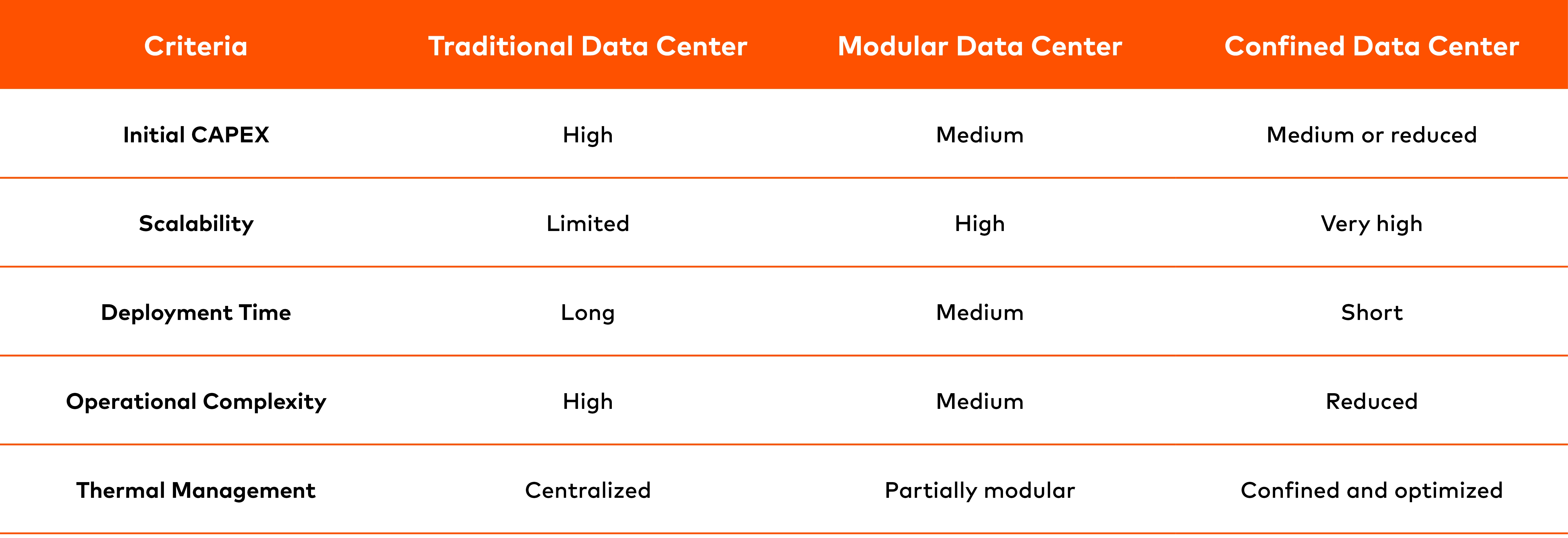 It is important to note that these values are qualitative characterizations, not universal metrics. Actual performance depends on the project, the technology used and the scale of the infrastructure.
Impact on Business and Infrastructure Strategy
Choosing between data center architectural models is not only a technical decision. It is also a strategic decision with direct impact on investment, risk and expansion speed.
Traditional models require high CAPEX and long-term planning, which can increase investment risk if future demand is uncertain.
Modular and confined architectures enable phased expansion, reducing the need for large upfront investments.
Another relevant factor is deployment time. In highly competitive environments, being able to activate computing capacity quickly can mean launching new services sooner or responding faster to demand peaks.
Finally, operational efficiency is also affected. Confined infrastructures can simplify thermal management, reduce energy losses and facilitate maintenance.
It is within this context that solutions based on confined infrastructure move beyond being merely a technical option and become a strategic tool. Approaches such as ORION by barpa help reduce the mismatch between investment and actual demand, giving organizations the ability to grow with greater control, reduce the risk of overinvestment and accelerate the launch of new services.
When Each Model Makes More Sense
Each architectural approach has scenarios where it becomes more suitable.
Traditional infrastructures remain relevant in large-scale data centers, where the final capacity is already known and operations will remain centralized for many years.
Modular data centers are particularly useful in projects that require gradual expansion, such as regional infrastructures or distributed cloud expansion.
The confined model can be especially interesting in scenarios such as:
- rapid capacity expansion
- edge computing environments
- installations with limited space
- projects requiring rapid deployment
In many cases, the decision is not binary. Organizations may combine different models within the same infrastructure strategy.
Conclusion
The evolution of digital infrastructures is changing the way data centers are designed and implemented.
While traditional architecture remains relevant for large-scale projects, models based on modularity and confined infrastructure offer greater flexibility to respond to the growing demand for computing capacity.
The concept of the confined data center represents an evolution of modularity by integrating power, cooling and IT into autonomous units that can be deployed and scaled more quickly.
For technical and business decision-makers, the choice of architecture should consider not only technological requirements, but also factors such as CAPEX, deployment speed, operational risk and digital growth strategy.
A careful analysis of these elements is essential to ensure that the infrastructure sustainably supports the organization’s future needs.
If your organization is under pressure to increase data center capacity in less time, with lower risk and more controlled investment, then it makes sense to evaluate models based on confined infrastructure.
ORION, developed by barpa, was created precisely to address this type of challenge, enabling capacity to be deployed in a fast, scalable way that remains aligned with the actual evolution of the business.
Instead of planning infrastructure years in advance, it becomes possible to grow incrementally, with greater predictability and lower operational complexity.
Speak with our team and evaluate how this approach can be applied to your infrastructure.

Sorry, the comment form is closed at this time.